Preparation
Step-by-step instructions
1
Introduction to the activity:
- Explain what mark making is and its importance in visual exploration.
- Share examples of different types of marks (dots, lines, textures, expressive gestures).
- Emphasize that the goal is not to create "perfect drawings," but to experiment with visual language.
2
Individual mark creation:
- Each participant receives a sheet with 50 blank squares.
- Over a set period (e.g., 15–20 minutes), they fill each square with a different mark using various tools and materials.
- Encourage quick strokes, varying pressure, textures, and tool combinations.
3
Selection of representative marks:
- Each person reviews their sheet and selects 5–10 marks they like most or that best represent their style.
- They may briefly explain why they chose those particular marks.
4
Creation of the collaborative mural:
- A large mural paper or designated surface is used.
- Each participant recreates their favorite marks on the mural, integrating them with others’ contributions.
- Encourage experimentation with collective composition, seeking connections and emerging patterns.
5
Reflection and observation:
- Observe the completed mural and discuss the connections among the different styles.
- Reflection questions:
- Did you discover anything new about how you make marks?
- How did seeing others’ marks influence your process?
- What elements in the mural best represent the group’s identity?
Materials
A3 sheets divided into 50 blank squares (one per participant)
Markers, pencils, brushes, chalk, charcoal, sponges, and other drawing materials
A large canvas, mural paper, or wall prepared for the collective composition
Adhesive tape or glue to attach the sheets to the mural
Optional background music to inspire creativity
Digital tools
Platforms
For virtual sessions or collaborative documentation.
Practical recommendations
Provide a wide variety of materials to encourage experimentation.
Create a relaxed, non-judgmental environment to foster free expression.
Use background music to inspire different rhythms and movements in the marks.
Vary the activity by introducing constraints such as “draw only with dots” or “use only one hand.”
Inspiration
Example of complete Mark Exploration sheet: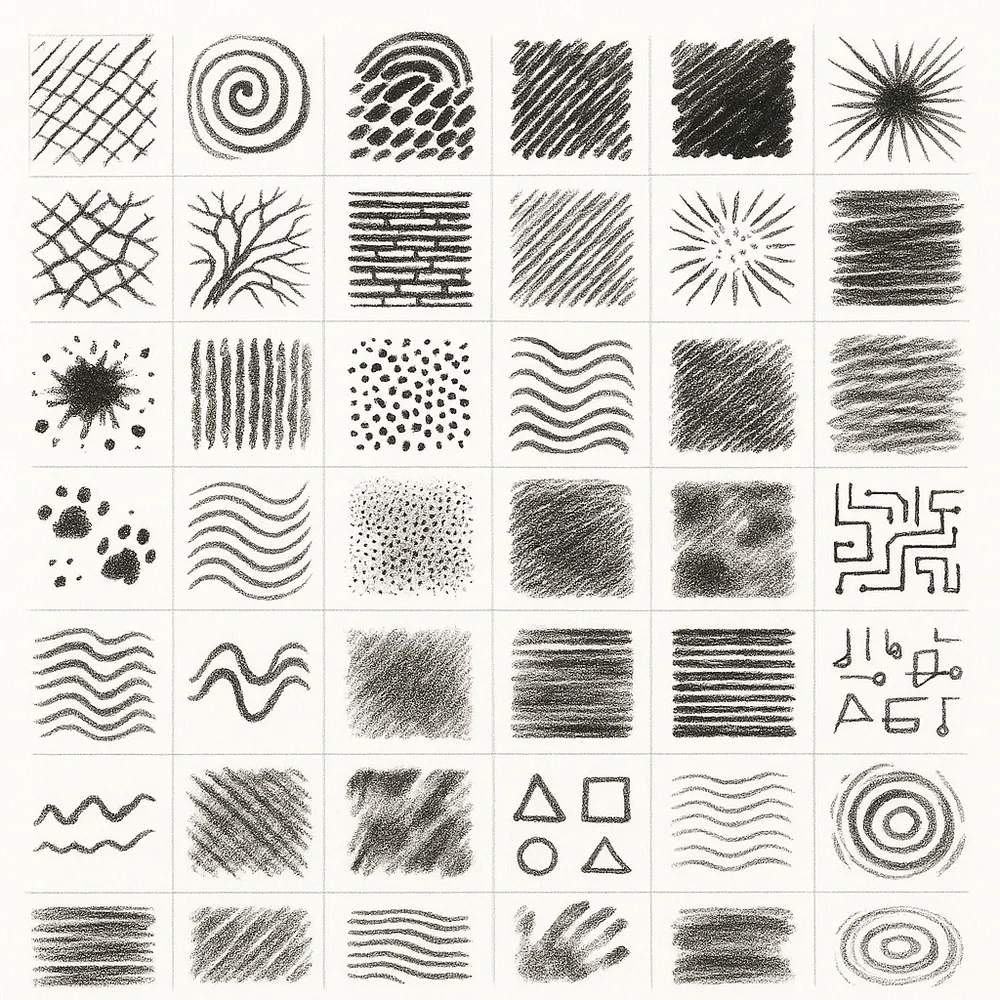 Types of marks that can be explored:
Types of marks that can be explored:- Organic marks: Lines and shapes inspired by nature (leaves, branches, roots).
- Animal textures: Representations of fur, feathers, scales, and shells.
- Gestural marks: Quick, expressive, and fluid strokes that reflect movement.
- Geometric pattern marks: Repetitive lines, dots, zigzags, and grids.
- Shading and gradient marks: Using variable pressure to create light effects.
- Broken line marks: Dotted lines, dashes, and segments.
- Writing-inspired marks: Abstract calligraphy, free typography, or letter-like marks.
- Symbolic marks: Icons, pictograms, or symbols representing ideas or concepts.
- Rhythmic marks: Sequences of lines or dots suggesting sound or music.
- Marks with line thickness variation: Combining thick and thin lines in one stroke.
- Accidental marks: Creations from stains, splashes, or smudges.
- Marks with unusual materials: Using sponges, corrugated cardboard, or natural elements.
- Emotion-inspired marks: Lines that reflect calmness, anger, joy, or tension.
- Abstract marks: Combinations of strokes with no figurative intention.
- Overlay marks: Different layers of lines and textures interacting with each other.
- Map-inspired marks: Lines imitating roads, rivers, borders, or territories.
- Figurative marks: Simplified representations of recognizable objects or figures.
- Curved line marks: Flowing and wrapping movements.
- Fractal-inspired marks: Forms that repeat at different scales.
- Material restriction: Each participant may only use one type of tool (brush, sponge, pencil, etc.).
- Single color use: All marks must be created using only one color, exploring tonal variations.
- Scale change: Some squares must be filled with tiny strokes and others with large marks.
- Shared marks: Each person completes a mark that was started by someone else.
- Teamwork: Each team creates a series of marks together to form a common pattern.
- Speed challenge: Short time limits are set for creating each mark to encourage spontaneity.
- Word prompts: Random concepts are assigned and each person creates a mark inspired by them.
- Exploration of contrasts: Soft vs. aggressive, orderly vs. chaotic, symmetrical vs. irregular marks.
- Style fusion: Combine different types of marks within a single square.
- Sensorial work: Create marks with eyes closed or in response to specific music.
- Emotion-driven marks: Draw lines that represent specific moods or feelings.
- Art history inspiration: Create marks inspired by artistic movements (Expressionism, Cubism, Surrealism).
- Interactive marks: A partner gives instructions on how the next mark should be made.
- Texture exploration: Reproduce on paper the texture of various tactile objects.