
Preparation
- Foster group cohesion and collaboration.
- Reflect on the connections between participants.
- Promote mutual understanding and teamwork.
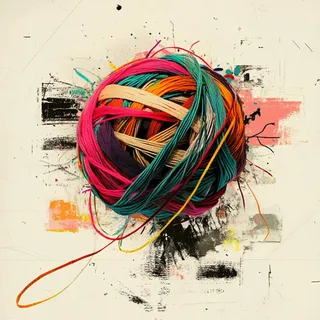
- A ball of thread, thin rope, or yarn.
- A spacious area where participants can form a circle.
- Optional: Cards or labels to identify roles or concepts.
- Arrange participants in a wide circle so everyone can see and hear each other easily.
Step-by-step instructions
Introduction to the purpose
- Explain to participants that they will work together to build a web that symbolizes their connections, roles, or ideas.
- Emphasize that the activity requires attention, active listening, and collaboration.
Initial presentation
- Ask each participant to introduce themselves or share something about themselves (e.g., an interest, a role, or a personal value).
- Start by handing the ball of thread to one person.
Building the web
- The first person holds onto the end of the thread and throws the ball to someone else while responding to a question or completing a prompt. Examples:
- “I choose because we both share an interest in…”
- “My experience in this topic connects with because…”
- The person who receives the ball holds onto a part of the thread and then throws the rest to another participant, following the same pattern.
- Repeat the process until all participants are connected and the web is fully formed.
Group reflection
- Once the web is created, guide the group in a discussion:
- What did they discover about their connections?
- What does the web represent for the group?
- How does it feel to be part of this network?
Optional: Additional interaction
- Ask some participants to gently pull on the thread to demonstrate how one action affects the entire network.
- Reflect on how collaboration and communication are essential to maintaining the network.
Closing and key takeaways
- Highlight how the activity reflects interdependencies and the value of working together.
- Thank participants for their openness and engagement.
Virtual Version of The Spider Web
In the virtual version of The Spider Web, participants connect through a collaborative platform where an interactive board is created. Each participant adds their name or an icon as a node on a shared screen. Guided prompts encourage participants to draw lines or arrows from their node to others, representing connections based on common interests, complementary roles, or shared experiences. During the activity, idea-sharing is encouraged through chat or microphones. At the end, the group reflects on the network formed, discussing the connections and learning how each individual contributes to the collective.
Materials
Practical recommendations
Adapt the prompt
Customize the questions or topics based on the group's purpose.
Encourage active listening
Ensure that each participant pays attention when sharing and receiving the thread.
Avoid interruptions
Allow the activity to flow naturally to maintain emotional connection.