Participatory Planning

Appreciative inquiry
Appreciative inquiry is an organizational and community change methodology that begins from what is already working well to build the desired future, rather than analyzing problems and deficits.

Citizens Assembly
Randomly selected citizens who deliberate on a complex policy question over weeks or months, producing evidence-based recommendations free from organized interests.
Delphi method
The Delphi method is a structured consultation technique that collects and synthesizes the judgment of a group of people through successive rounds of questionnaires and anonymous feedback, progressively converging toward an informed consensus.

Force field analysis
Force field analysis is a participatory analysis tool developed by Kurt Lewin that helps a group identify the forces driving a desired change and those restraining it, in order to design strategies that strengthen the former and weaken the latter.

Future Search Conference
Conference method that brings all system stakeholders together for 2–3 days to build shared understanding and co-create an actionable common future.

Golden circle
The golden circle is a strategic reflection tool based on Simon Sinek's model that guides people, teams, or organizations to clarify their purpose (Why), their methods (How), and their actions (What), always starting from the center.

Nominal Group Technique (NGT)
Participatory technique combining silent idea generation and anonymous voting to produce ranked priority lists free from hierarchical influence and social pressure.

Participatory Budgeting
Democratic process where community members vote directly on how to spend part of the public budget — turning citizens into active co-designers of public investment.

Participatory Scenario Planning
Method for thinking under uncertainty: diverse stakeholders build four plausible futures, then identify strategies robust enough to hold regardless of which scenario unfolds.
Public Consultation
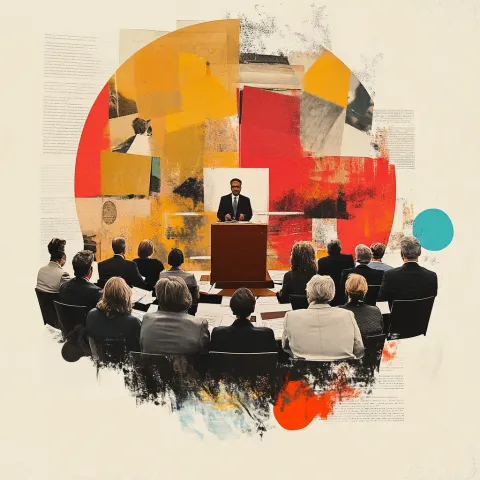
Formal process for collecting public input on proposed decisions before they are finalized, with explicit links between what was heard and how it shaped the outcome.

Sprint Retrospective
Agile team practice: structured session at the end of a sprint to examine what worked, what didn't, and commit to concrete improvements for next time.

Technology of Participation (ToP)
ICA facilitation system with three core methods — ORID Focused Conversation, Consensus Workshop, and Action Planning — to move groups from reflection to committed action.