Preparation
01 · Define the purpose
- Foster collective creativity and synchronization within teams.
- Explore non-verbal communication and adaptability in collaboration.
- Promote fun and shared learning in a relaxed environment.
02 · Prepare the materials
- Large sheets of paper or whiteboards.
- Pencils, markers, crayons, or brushes (depending on the desired style).
- Timer or stopwatch for timed variations.
- Ample tables or comfortable spaces for group work.
03 · For virtual implementation
- Use collaborative platforms that allow real-time drawing or visual sharing, such as digital whiteboards or design tools.
Step-by-step instructions
1
Introduction:
- Explain that the goal is to work together to create a synchronized and collaborative drawing.
- Clarify that perfection is not required; the focus is on coordination and creative connection.
- Divide the group into pairs or small teams (3–4 people).
2
Drawing preparation:
- Provide each group with a large sheet of paper.
- Define areas on the paper for each participant to contribute their part.
3
Synchronized drawing:
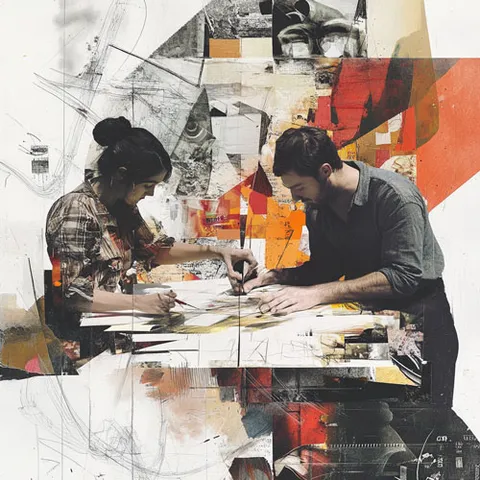
- One participant starts the drawing while others follow their lead or expand on the idea. In pairs, one leads while the other follows.
- Rotate roles according to the variations or set specific times for each turn (e.g., 1–2 minutes per turn).
4
Completion and reflection:
- Once the drawings are complete, have each group share and explain their creations.
- Facilitate a discussion on challenges, learnings, and experiences from the exercise.
Materials
Large sheets of paper or digital whiteboards
Pencils, markers, or crayons
Timer or stopwatch
Practical recommendations
Before the activity
Create a relaxed and judgment-free atmosphere to encourage creativity.
During the activity
Maintain clear timing and encourage participants to follow the creative flow without worrying about the final result.
After the activity
Facilitate a group reflection on the experience and how it relates to collaboration in other contexts.
Inspiration
Variations to enrich the activity:
- Switch leaders: Rotate leadership roles during the drawing process.
- Non-dominant hands: Participants must use their non-dominant hand to draw.
- Drawing blind: One participant draws while others follow without directly looking.
- Separate pages: Participants replicate their partner’s drawing on a separate sheet.
- Switch teams: Participants switch partners mid-drawing to continue someone else’s creation.
- Represent an abstract concept like "happiness" or "creativity."
- Draw a shared landscape where each participant adds an element.
- Create a team mascot or character.
- Illustrate a problem and its solution.
- Draw something related to the group’s work or educational context.