Preparation
01 · Define the purpose
- Strengthen group cohesion and collaboration.
- Promote team problem-solving.
- Encourage effective communication and mutual trust.
02 · Prepare the space
- Select a spacious, clear area where participants can move safely.
03 · To conduct the activity virtually
- Use collaborative platforms to simulate a conceptual "knot": participants share complex ideas or situations and work together to untangle or resolve them.
Step-by-step instructions
1
Form the knot:
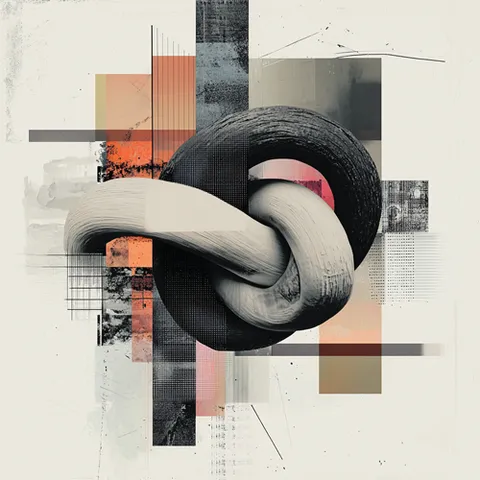
- Ask participants to form a circle and hold hands with non-adjacent people.
- Ensure each person is randomly connected to two different participants.
2
Untangle the knot:
- Instruct the group to carefully untangle the "human knot" without releasing hands.
- Encourage participants to communicate and collaborate to find solutions.
3
Rules and safety:
- Participants must not release hands during the activity unless necessary for comfort or safety reasons.
- Remind participants to move carefully to avoid injury.
4
Group reflection:
- After resolving the knot, guide the group in a discussion about what they learned regarding collaboration, communication, and problem-solving.
Materials
Spacious, clear area
Timer (optional)
Posters or whiteboards to note reflections (optional)
Props for variations (optional)
Practical recommendations
Encourage a relaxed environment so participants feel comfortable engaging physically.
Adapt the activity for larger groups by dividing participants into smaller subgroups.
Remember that the goal is learning and enjoyment, not competing to untangle the knot quickly.
Include a brief introduction on the importance of collaboration before starting the activity.
Use background music to make the activity more dynamic and enjoyable.
Inspiration
Reflection questions:
Include questions that connect the activity with everyday learnings or challenges, promoting meaningful reflection:
- What strategies did we use to solve the "knot"? How do they relate to real-life or workplace challenges?
- How does communication influence group problem-solving?
- What did we learn about the importance of patience and active listening in complex situations?
- How did each group member contribute to overcoming the challenge?
- How can we apply this learning to collaborative projects in our environment?
- What emotions emerged during the activity, and how did they influence our group dynamics?
- What would we do differently if we repeated the exercise?
- How could we use this approach to resolve conflicts or barriers in other contexts?
- What roles did different participants assume during the activity?
- What does this activity teach us about the importance of trust and cooperation?
Provide alternative adaptations of the activity tailored to specific themes or groups:
- Knot of Ideas: Instead of a physical knot, create a conceptual knot where participants connect ideas or problems and then untangle the connections to seek solutions.
- Role Knot: Each participant takes on a specific role (leader, facilitator, mediator) while working to untangle the knot, promoting analysis of team roles.
- Cultural Knot: Use the activity to explore how different cultures approach group challenges, incorporating elements representative of diversity.
- Workplace Challenge Knot: Relate the activity to common workplace issues, such as team coordination or conflict resolution.
- Environmental Knot: Represent sustainability issues (like resource management) and ask participants to reflect on how to collaboratively solve them.
- Planning Knot: Adapt the activity so participants "untangle" key steps in a project or event they must organize together.
- Personal Knot: Invite participants to connect personal challenges with the knot-solving process, reflecting on group support.
- Virtual Knot: Use digital tools to simulate a conceptual knot with ideas, data, or processes that participants must reorganize to find solutions.
- Community Knot: Connect the activity to specific community issues, such as infrastructure or communication, to find practical solutions.
- Narrative Knot: Each participant contributes part of a story that, upon resolving the knot, creates a group narrative about teamwork or overcoming challenges.