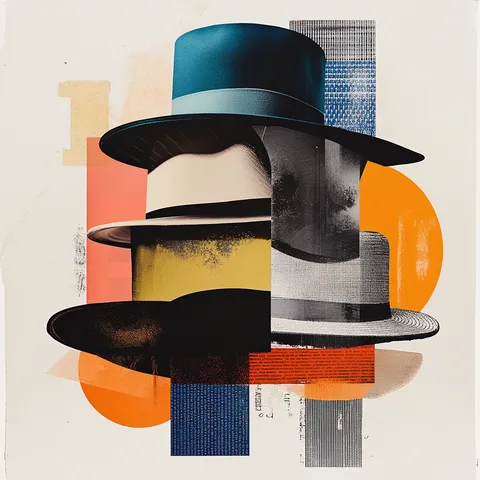
The six hats
- White Hat (Facts) Objective data and information. What do we know? What do we need to find out?
- Red Hat (Emotions) Feelings, intuitions, and gut reactions — no justification required.
- Black Hat (Caution) Critical thinking, risks, and reasons why something might not work.
- Yellow Hat (Optimism) Benefits, value, and why something could succeed.
- Green Hat (Creativity) New ideas, alternatives, provocations, and creative possibilities.
- Blue Hat (Process) Managing the thinking process itself — the facilitator's hat, used to open and close sessions and summarize outputs.
Preparation
01 · Select the topic
- Choose a specific problem, project, or decision that benefits from structured multi-perspective analysis.
- Frame it as a clear, concrete question the group will think about together.
02 · Explain the method
- Introduce each hat's color and its associated thinking mode.
- Emphasize that everyone wears the same hat at the same time — this is parallel thinking, not debate.
03 · Prepare materials
- Colored hat cards, printed signs, or digital color cues for each hat.
- A flip chart or shared board to capture each hat's contributions.
- A timer for each hat phase (5–10 minutes each).
Step-by-step instructions
1
Blue Hat opens (2–3 min)
- Facilitator states the objective, the sequence of hats to be used, and the ground rules.
2
White Hat — Facts (5–10 min)
- Group shares known data, relevant information, and identifies key knowledge gaps.
- No opinions or interpretations — only verifiable facts.
3
Yellow Hat — Optimism (5–10 min)
- Group explores the genuine benefits, value, and best-case potential of the topic.
- Even skeptics must think from this angle during this phase.
4
Black Hat — Caution (5–10 min)
- Group identifies real risks, weaknesses, obstacles, and reasons for concern.
- This is not pessimism — it is careful, logical critical thinking.
5
Green Hat — Creativity (5–10 min)
- Group generates alternatives, new approaches, and creative ideas without judgment.
- Provocations and wild ideas are welcome.
6
Red Hat — Emotions (3–5 min)
- Participants briefly share their feelings, gut reactions, or intuitions about the options explored so far.
- No justification needed — "I feel..." is enough.
7
Blue Hat closes (5–10 min)
- Facilitator summarizes the key outputs from each hat.
- Group identifies priorities, decisions, or next steps.
Materials
Six colored hat representations (physical hats, printed cards, or digital images)
Flip chart, whiteboard, or collaborative digital board
Timer visible to the group
Note-taking materials or shared document for capturing each hat's outputs
Digital tools
Platforms
For virtual sessions or collaborative documentation.
Practical recommendations
Assign a firm Blue Hat facilitator
Someone must keep the group within the active hat's perspective. Mixing hats mid-phase undermines the method's power.
Don't skip the Red Hat
Emotions and intuitions carry important signal. Naming them explicitly prevents them from leaking unacknowledged into other phases.
Adapt the sequence
You don't always need all six hats. For quick creative work, use Green + Yellow. For risk assessment, focus on White + Black.
Use with stuck groups
Six Thinking Hats is especially powerful when a team keeps revisiting the same argument without resolution — the structure breaks the loop.
In virtual settings
Use colored emoji or digital card images in chat to signal hat transitions. Assign a hat color visually on the shared screen.
Inspiration
Application examples by context:
- Business strategy: Evaluating a new product launch — White (market data), Yellow (revenue potential), Black (competitive risks), Green (alternative models), Red (team gut feeling), Blue (decision).
- Education: Analyzing an ethical dilemma or historical event from six structured angles, helping students practice multi-dimensional thinking.
- Community planning: Assessing a proposed policy, ensuring citizen feelings (Red), expert data (White), creative alternatives (Green), and risks (Black) all have dedicated space.
- Organizational change: Before implementing a restructuring plan, running the hats to surface unspoken concerns (Red, Black) and genuine enthusiasm (Yellow) — making the decision more robust.