Preparation
01 · Choose or create the talking object
- It can be any object that holds meaning for the group: a stone, a branch, a handmade object, a symbol of the community.
- Involving the group in choosing the object deepens their connection to the practice.
02 · Set up the space in a circle
- Arrange chairs in a circle without tables, so all participants can see each other's faces.
- If possible, place a small center table with something meaningful: flowers, a candle, symbolic objects.
03 · Define the opening question or topic
- Prepare one or two open questions that invite authentic sharing rather than debate.
- Examples: "What brought you here today?" / "What does this community mean to you?" / "What would you like to leave behind before we begin?"
Step-by-step instructions
1
Opening of the circle
- The facilitator opens the circle with a brief centering moment: a breath, a minute of silence, or a few words that mark the transition into circle space.
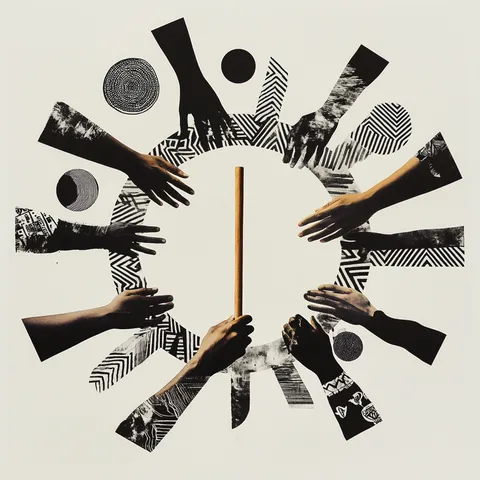
- Explain the rules: only the person holding the talking stick speaks; everyone else listens without interrupting, without responding, without making evaluative gestures.
- Clarify that it is always okay to pass the object without speaking.
2
Passing the talking stick
- The facilitator begins, models the tone of sharing, and passes the object to the next person in the circle.
- The object travels around the circle until it has passed through every pair of hands.
- The facilitator gently intervenes if someone speaks while not holding the object, without making it a correction: "Let's wait until the stick comes to you."
3
Optional second round
- After a first round where everyone has spoken, a second round can be opened for responses, additions, or connections.
- At this point, the energy of the circle usually flows with more ease.
4
Closing of the circle
- The facilitator closes the circle with a brief acknowledgment of what was shared, without summarizing or evaluating the content.
- A closing gesture or short ritual can mark the end of the circle space.
Materials
A talking object (stick, stone, ball, or any meaningful object)
Chairs arranged in a circle
Optional: central table with meaningful elements
Practical recommendations
Model the tone with the first round: if the facilitator shares authentically and briefly, the group usually follows.
The "pass" option is essential: never force anyone to speak. Respecting silence is part of the circle practice.
Use it at the opening or closing of sessions, not only when there is a conflict. The more familiar a group is with the circle, the more powerful it becomes in difficult moments.
In virtual settings, the talking stick works best when participants keep their cameras on and the facilitator clearly names who holds the virtual object at each moment.
With children and youth: using a physical object they themselves choose or decorate increases their sense of ownership over the practice.
Inspiration
Opening questions by context:
- Beginning of school year: "What is one word that describes how you arrive today?"
- After a conflict: "What do you need to feel heard in this circle?"
- Team retrospective: "What are you proud of from this process, and what would you have done differently?"
- Community meeting: "What does this neighborhood / organization / community mean to you personally?"
- Closing circle: "What are you taking away from this experience?"
- Themed circle: Each round focuses on a specific question; the talking stick travels multiple times.
- Reflective circle: The second round responds not to the facilitator's question but to something another participant said.
- Peacemaking circle: Restorative practice format in which the talking stick structures a conversation to repair a relationship or resolve a conflict (see also: Restorative Circle).
- Virtual talking stick: In online sessions, use a digital timer, a raised hand, or a symbolic image passed turn by turn.
Consulted sources
- Pranis, K. (2005). The Little Book of Circle Processes. Good Books.
- Boyes-Watson, C. & Pranis, K. (2015). Circle Forward: Building a Restorative School Community. Living Justice Press.
- Lederach, J. P. (2005). The Moral Imagination: The Art and Soul of Building Peace. Oxford University Press.