
Preparation
01 · Design meaningful questions
- Craft 1 to 3 powerful, open questions that genuinely matter to the participants and the purpose of the gathering.
- Questions should invite exploration, not have obvious right answers (e.g., "What would need to be true for our community to thrive in 10 years?").
- One question can be used across all rounds, or each round can explore a different dimension of the same theme.
02 · Set up the space like a café
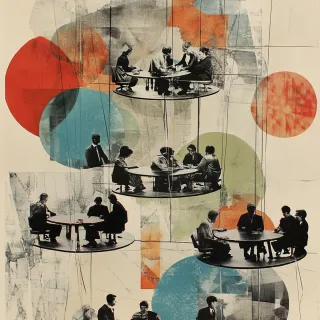
- Arrange small tables for 4–5 people each, covered with paper tablecloths or large sheets of paper.
- Place markers, colored pens, and printed question cards on each table.
- Create a warm, welcoming atmosphere — flowers, candles, music — to signal that this is not a formal meeting.
03 · Assign table hosts
- Each table has one host who stays at the table for all rounds.
- The host synthesizes the previous conversation for each new group of travelers.
- Rotate host responsibility or ask for volunteers before starting.
Step-by-step instructions
1
Welcome and framing (10–15 min)
- Explain the purpose, the question(s), and how the Café works.
- Introduce the Café etiquette: listen to understand, build on each other's ideas, draw on the paper, speak your mind and heart.
- Invite participants to take notes and doodles directly on the paper tablecloths — the table surface is a shared canvas.
2
Round 1 (20–30 min)
- Participants gather at their first table and begin exploring the question.
- The table host facilitates gently, ensuring all voices are heard.
- Encourage drawing connections, patterns, and key words directly on the paper tablecloth.
3
Rotation (2–3 min)
- When time is called, participants (except the host) move to a different table.
- Mix tables so that travelers come from different previous conversations.
4
Round 2 (20–30 min)
- The host welcomes new travelers and briefly summarizes key insights from the previous round.
- New participants connect their previous conversation's ideas with what's on the table.
- The dialogue deepens and cross-pollinates.
5
Round 3 (20–30 min)
- A third rotation deepens connections further.
- Participants may optionally return to their original table to see how the conversation has evolved.
6
Collective Harvest (20–30 min)
- Bring the whole group together in plenary.
- Each table host shares 2–3 key insights or patterns from their table.
- Facilitator maps emerging themes visually on a large shared canvas or wall.
- The group identifies shared insights, tensions, and possible next steps.
Materials
Small round tables (4–5 chairs each)
Paper tablecloths or large sheets of paper for each table
Colored markers for writing and drawing on tables
Printed question cards for each table
A large wall or canvas for the collective harvest
Warm café ambiance (optional but recommended: music, flowers, beverages)
Practical recommendations
The question is everything
Invest serious time designing the café question. A poor question produces a poor conversation, regardless of the format.
Train your table hosts
Hosts don't present — they welcome, synthesize, and listen. Brief them on this distinction before starting.
Embrace the noise
Multiple simultaneous conversations are a feature, not a problem. The energy of the room is generative.
Don't rush the harvest
The collective harvest is where the café's value becomes visible. Give it adequate time and visual documentation.
Virtual adaptation
Use breakout rooms as tables, with a designated host in each. Use a shared Miro or Mural board as the paper tablecloth. The harvest happens in plenary with hosts sharing their board section.
Inspiration
Application examples by context:
- Strategic planning: "What kind of organization do we want to be in 5 years, and what would need to change to get there?" — multiple rounds surface distributed wisdom across all levels of the organization.
- Community consultation: "What does a healthy neighborhood look like for everyone who lives here?" — citizens across ages and backgrounds contribute equally to defining shared priorities.
- Education: "What makes learning meaningful?" — students, teachers, and families explore together, generating a shared vision for the school culture.
- Conference design: Replace panels and keynotes with a World Café so that all 80 attendees contribute to the same knowledge-building process.